Product Design / 2024–2026
Alexa+ Customer Experience Platform
Defined the AI interaction model for Alexa+ Experts, creating scalable conversational experiences that connected customers with partners through a consistent, AI-native platform rather than traditional voice skills.
Part of Alexa+ AI Developer Platform
Challenge
Reinvent how customers interact with services through Alexa by replacing traditional skill-based experiences with AI-powered Experts capable of understanding intent, coordinating multiple partners, and guiding customers through complex tasks using natural conversation.
Strategy
Establish reusable conversational Experts for entire service categories, separating customer experience from partner implementation so new integrations, SDKs, and business models could expand the ecosystem without changing how customers interacted with Alexa.
Design Approach
Define consistent interaction principles centered on understanding, personalization, guidance, history, and trust while allowing platform capabilities and partner integrations to evolve independently beneath the experience.
Scope
Customer experience strategy spanning conversational AI, category ownership, partner integration frameworks, cross-device experiences, multimodal interactions, AI behavior, operational quality, and agentic workflows.
Outcome
Established the customer experience architecture for AI-powered Experts that enabled Alexa+ to scale across partners, categories, devices, and integration models while maintaining one consistent conversational experience.
From voice skills to intelligent Experts
Alexa’s original ecosystem centered around individual skills. Every experience was built as a separate destination that customers had to discover, enable, and invoke.
Alexa+ introduced a fundamentally different model.
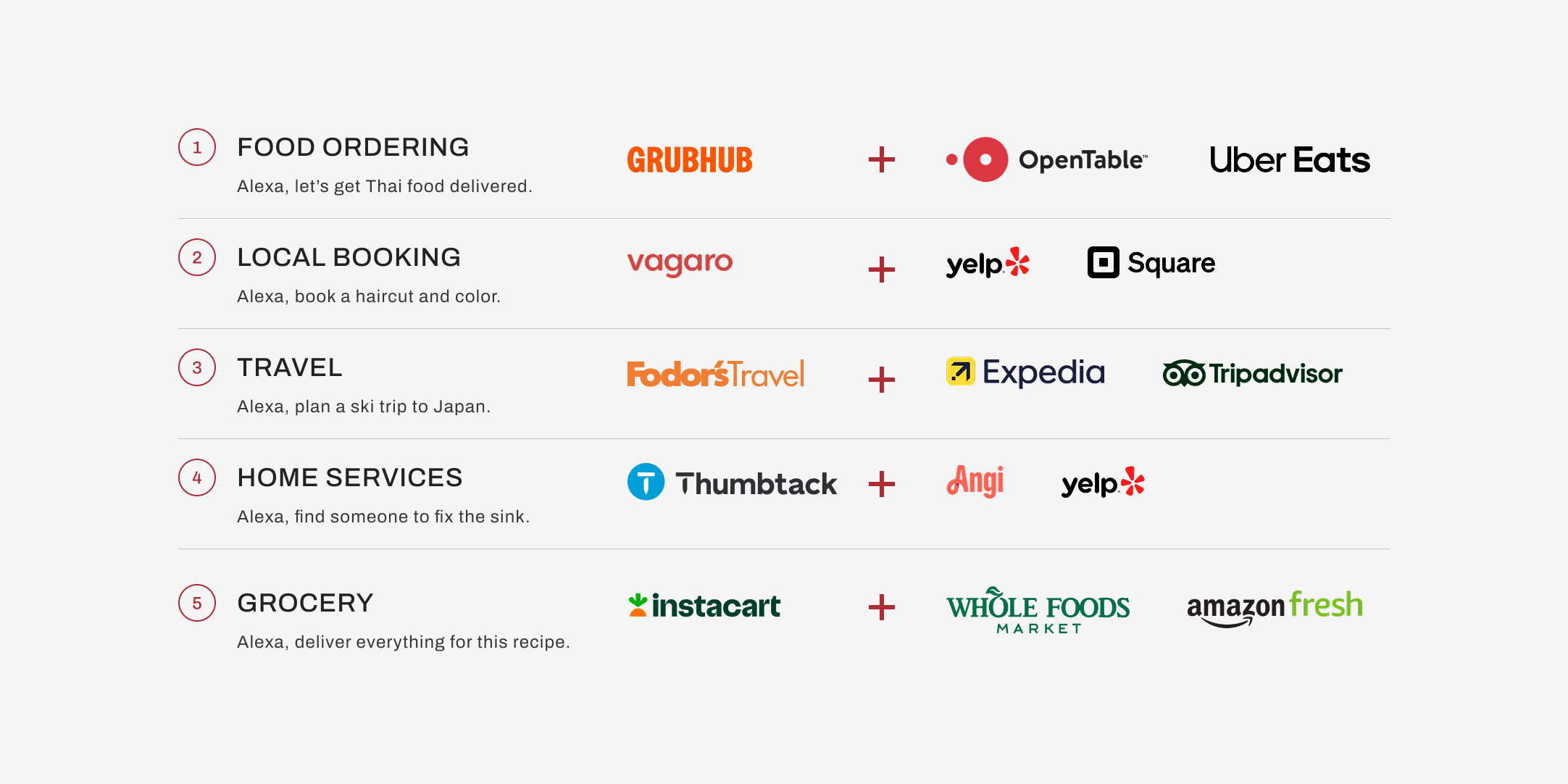
Instead of creating individual experiences for every partner, we designed AI-powered Experts that understood an entire vertical domain such as food ordering, travel, grocery, or home services. Partners were then integrated into those Experts rather than standalone destinations. We called these Integrations.
Customers no longer needed to know which company provided a capability or how to invoke it. They simply described what they wanted to accomplish, and the Expert determined the appropriate actions, coordinated with partner services, and guided the conversation toward a successful outcome.
My responsibility was defining the customer experience strategy for these Experts, establishing how each category behaved, and ensuring new partners could integrate without changing the interaction model customers had already learned.
Designing the conversation instead of the integration
The interaction model needed to remain consistent regardless of which partner ultimately fulfilled the request.
Customers should never need to learn different conversational patterns simply because they were ordering dinner instead of booking travel or scheduling a home service.
Each Expert established reusable behaviors for an entire category.
That meant defining how Alexa:
- understood customer intent
- clarified ambiguity
- selected appropriate partners
- explained recommendations
- confirmed important decisions
- recovered from interruptions
- remembered conversational history
- transitioned naturally across devices
Partners could innovate within their own experiences while customers always interacted with one consistent Alexa personality.
One experience, many integration models
Partners entered the Alexa ecosystem with very different technical capabilities.
Some exposed traditional APIs.
Others required robotic website automation.
Some delivered their own AI agents.
Others adopted the Model Context Protocol (MCP).
Supporting that diversity required multiple integration approaches while preserving one customer experience.
The platform expanded through:
- Actions SDK for partner APIs
- Web Actions SDK for robotic website automation
- Agent SDK for partner AI agents
- MCP Applications for Model Context Protocol integrations
The implementation changed.
The customer experience did not.

Building reusable Experts instead of one-off experiences
Each Expert established the interaction patterns for an entire customer domain rather than a single partner.
That allowed the platform to accommodate different business models, customer preferences, fulfillment strategies, and partner capabilities while maintaining a familiar conversational experience.
The same architectural approach supported expansion into six new service categories without increasing interaction complexity for customers.
Designing for trust at AI scale
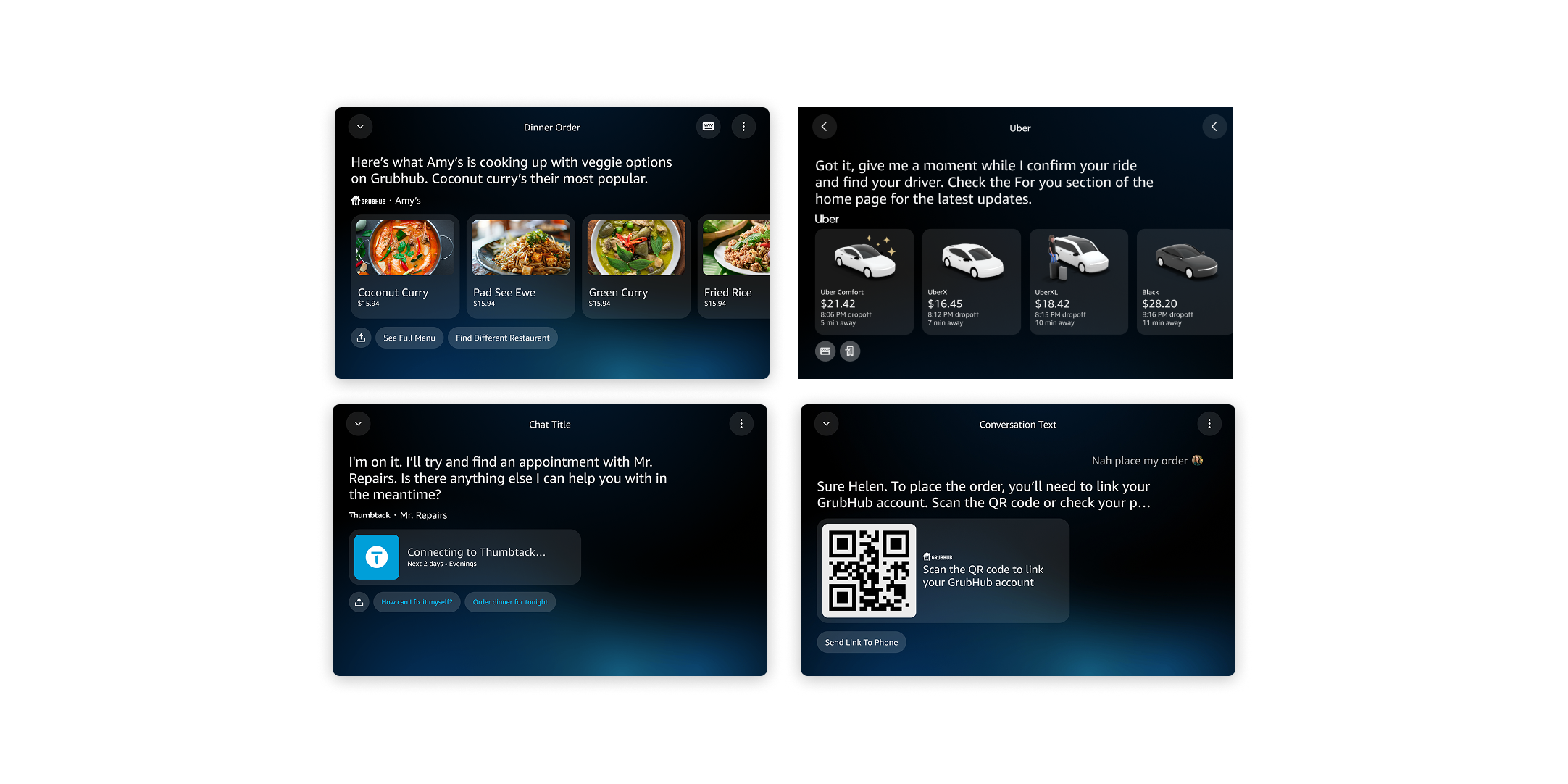
Every interaction balanced AI capability with customer trust.
Several foundational principles guided the behavior of every Expert.
Understanding
Interpret customer intent while resolving ambiguity before taking action.
Personalization
Leverage customer, household, and historical context whenever appropriate.
Guidance
Help customers reach the right solution using the fewest possible conversational steps.
History
Preserve conversational context so users could naturally recover after interruptions or topic changes.
At the same time, important design tradeoffs remained consistent across every experience.
- Customers should never need to restate their intent.
- AI confidence should match actual system reliability.
- High-risk actions require explicit confirmation.
- Interaction patterns remain consistent across devices.
- Information should always be clearly attributed to partners.
- Components adapt naturally across multimodal endpoints.
One customer experience across every device
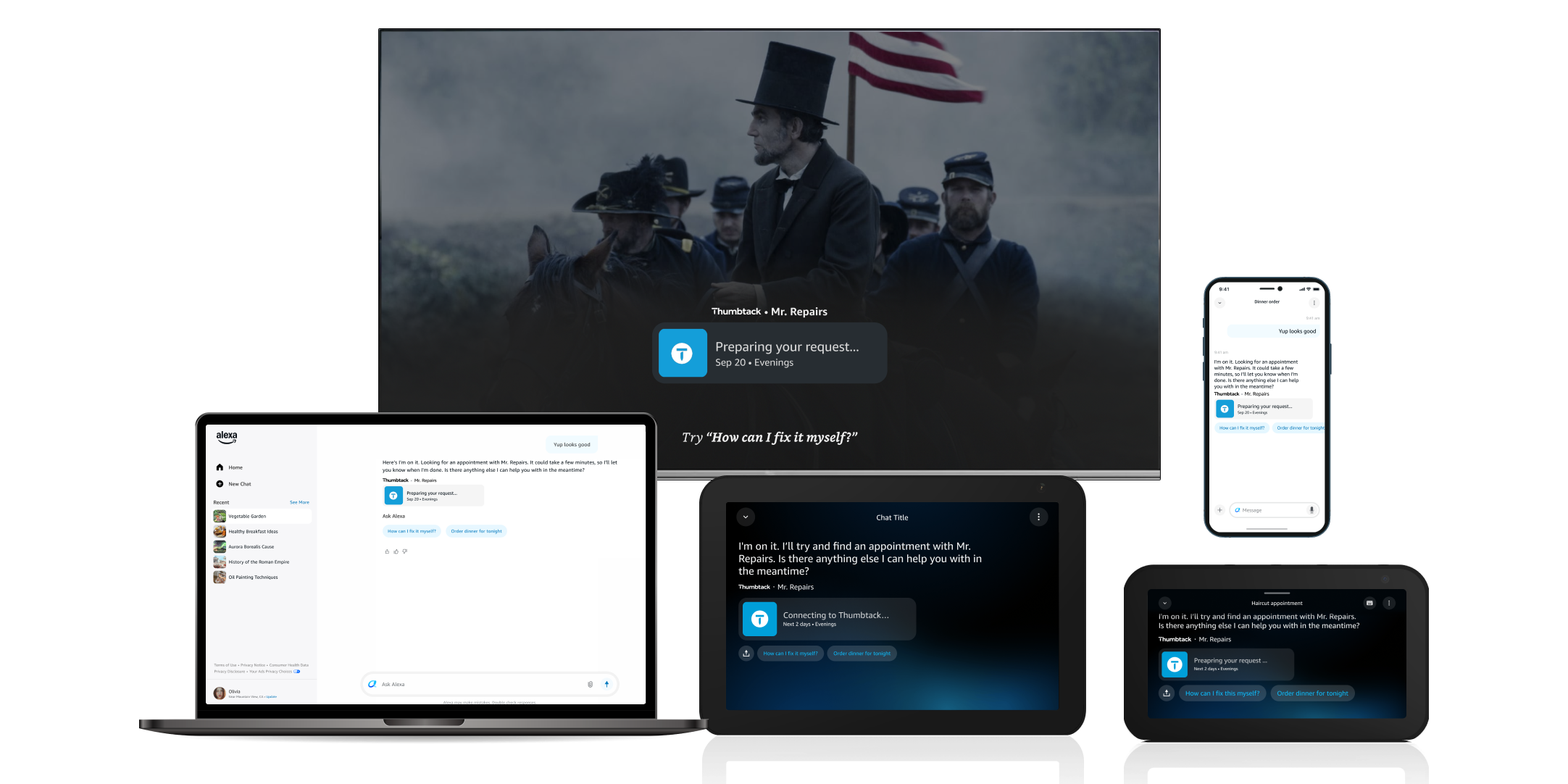
Customers naturally moved between Echo devices, mobile phones, displays, automobiles, and partner applications while completing a task.
My ownership included defining interaction principles that remained recognizable across endpoints while allowing layouts, components, and content fragments to adapt to each device’s capabilities.
Consistency became an architectural principle rather than a visual one.
Why it mattered
Alexa+ redefined the relationship between customers and services.
Rather than asking customers to discover and navigate individual partner experiences, the platform introduced AI-powered Experts that understood goals, coordinated the appropriate integrations, and maintained one consistent conversational experience regardless of who fulfilled the request.
The lasting contribution was not a collection of customer flows. It was the interaction architecture for a new generation of AI-native service experiences that could scale across partners, categories, devices, and evolving technologies.