AI Platforms / 2020–2026
Alexa+ AI Developer Platform
Defined the AI-native platform connecting Amazon teams, partners, and AI systems to build, integrate, and scale the next generation of Alexa experiences.

Challenge
Transform Alexa from a voice assistant into an AI-native platform supporting developers, partners, and future conversational experiences.
Strategy
Create a unified experience platform connecting developer workflows, AI-assisted knowledge, partner integrations, reusable design systems, and operational tooling.
Design Approach
Design for people rather than organizational systems by creating reusable experience frameworks that scale across teams, tools, and AI capabilities.
Scope
Experience strategy spanning developer experience, Alexa+ Studio, partner integrations, operational workflows, AI evaluation, and design systems.
Outcome
Established the experience foundation enabling Amazon teams and partners to build, integrate, and evolve Alexa+ capabilities through a unified AI-native platform.
From voice assistant to AI platform
Alexa+ represented a fundamental shift in how Amazon thought about voice experiences.
Rather than responding to predefined commands, Alexa was evolving into an AI-native platform capable of understanding intent, coordinating across services, integrating with external systems, and supporting increasingly autonomous experiences.
Building that future required much more than a new customer interface. It required a platform that enabled hundreds of engineers, designers, product managers, TPMs, researchers, and external partners to work together around a shared understanding of capabilities, workflows, and quality.
My role focused on defining the experience architecture that connected those communities and made the platform understandable, scalable, and usable.
An ecosystem instead of an application
Unlike traditional software products with a single customer, Alexa+ served multiple audiences simultaneously.
Amazon engineers needed efficient workflows for building, testing, debugging, and deploying AI capabilities.
Designers, product managers, TPMs, and researchers needed a shared understanding of platform capabilities, implementation patterns, and customer experiences.
External partners needed intuitive ways to integrate devices, APIs, SDKs, and services into the Alexa ecosystem.
Ultimately, millions of Echo customers experienced the results without ever seeing the platform behind it.
Designing for that ecosystem meant treating the platform itself as a product.

Building for people instead of systems
Large technical organizations naturally organize around services, APIs, repositories, and ownership boundaries.
People don’t.
Developers think about solving problems.
Partners think about shipping integrations.
Product managers think about capabilities.
Designers think about customer outcomes.
One of the core principles behind the platform was organizing experiences around the work people were trying to accomplish rather than the internal systems that implemented those capabilities.
That principle influenced everything from developer workflows and partner experiences to knowledge architecture and AI-assisted guidance.

Four connected platform capabilities
Rather than building disconnected tools, we developed a platform composed of complementary capabilities that worked together.
Developer Experience Platform
Operational workflows supporting investigation, diagnostics, deployment readiness, AI-assisted debugging, orchestration, and developer productivity across the software development lifecycle.
Alexa+ Studio
An AI-native knowledge platform transforming APIs, SDKs, documentation, implementation guidance, and organizational knowledge into an interactive development experience.
Partner Experience & Integrations
Experiences enabling device manufacturers, API providers, and service partners to successfully onboard, integrate, certify, and evolve Alexa capabilities.
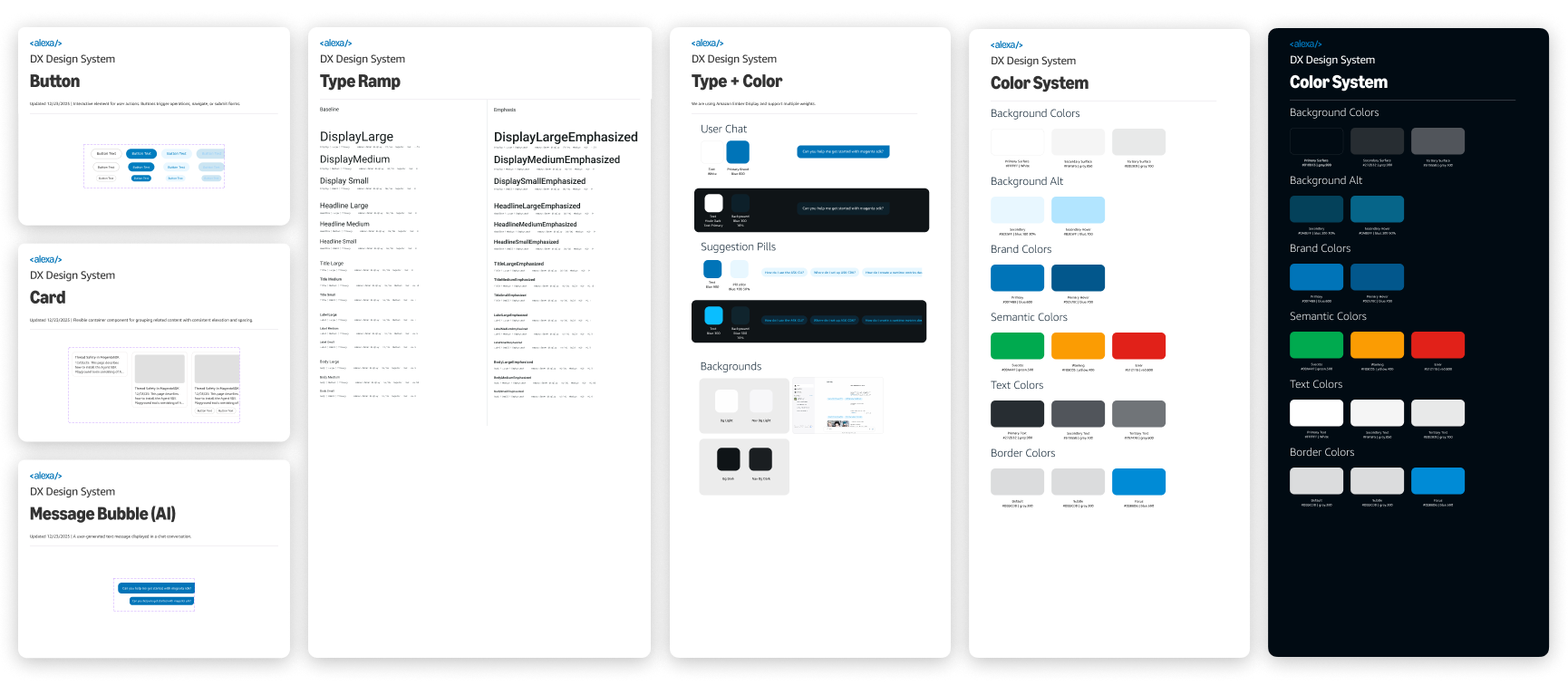
Alexa Developer Design System
Reusable interaction patterns, component libraries, governance, and implementation standards aligning designers and engineers across a rapidly evolving platform.
Together these capabilities created a cohesive experience rather than a collection of independent products.
Designing a platform that could evolve
The platform was designed with change as a constant.
New AI capabilities, partner integrations, APIs, orchestration patterns, and evaluation systems would continue to emerge. Rather than designing for a fixed set of features, we established reusable experience frameworks that could absorb new capabilities without forcing users to relearn how the platform worked.
Information architecture, interaction models, workflow patterns, documentation, and reusable design components all became part of a shared foundation supporting long-term platform growth.
This shifted the design conversation away from individual features and toward creating systems that could continuously evolve.
Industry momentum
As Alexa+ matured, Amazon publicly introduced many of the platform capabilities the organization had been building toward.
Announcements highlighted AI-powered developer tooling, expanded smart home partner integrations, richer manufacturer capabilities, and adoption of the Model Context Protocol (MCP) to simplify external service integration. Public reporting also described increased customer engagement among Alexa+ users and broader partner adoption of the platform direction.
While those announcements focused on customer-facing capabilities, my work centered on the internal platform experiences that enabled Amazon teams and partners to design, build, validate, and operate those capabilities at scale.
Why it mattered
The most successful platforms don’t simply make software easier to build.
They create a shared understanding across organizations.
By connecting developer workflows, AI-assisted knowledge, partner enablement, reusable design systems, and operational experiences into a unified platform, Alexa+ shifted teams away from navigating disconnected systems and toward building together within a common experience architecture.
The supporting case studies explore the major capabilities that made that platform possible.